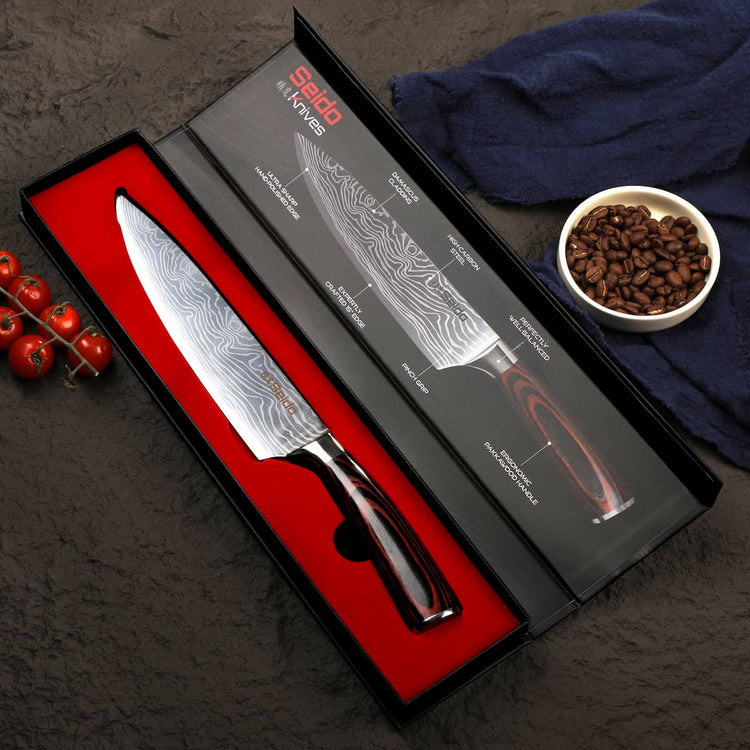
Any seasoned chef or home cook will tell you that without high-quality knives, food and flavors cannot reach their full potential. There are several essential knives that chefs will not do without, and the “workhorse” of the kitchen is the amazing chef knife.
You have many options when it comes to purchasing this important cutlery, but not every knife of this type is of equal quality. There are cheap copycats, but their longevity and precision leave much to be desired. Take a look at this professional guide before you do your shopping.
Knife Anatomy 101
If you have always believed that a knife is just a knife, expert chefs would strongly disagree. Certain parts of a knife indicate how exceptional this kitchen tool truly is.
When looking for a chef’s knife that can perform in almost every meal preparation task, including slicing, chopping, dicing, and mincing, the blade and handle are the key features to consider. Think of it as “Knife Anatomy 101.”
This versatile knife has come a long way since Philippe Sabatier debuted it during the 1830s in France. The slightly curved blade toward the tip made the knife ideal for the “rocking” motion chefs use when chopping. Today, a top-notch chef’s knife delivers speed, efficiency, and comfort and enhances the quality of the chef’s output.
The Blade
Whether you purchase a Western or Japanese knife, a superbly made blade will give you clean, precise cuts on every food imaginable, enhancing its appearance and texture and reducing prep time. This knife type is the backbone of your kitchen, and a razor-sharp blade offers you a higher degree of control when working with this culinary tool. Dull-bladed knives are the ones that typically cause accidents.
A knife with an outstanding blade provides an engineered cutting angle for superior precision. A blade built from high-quality steel will also have a significant impact on how long the blade remains razor-sharp.
The pointed front end or tip of the knife’s blade allows for tasks that require precise and detailed cutting as well as making guide cuts. There is also the blade’s belly, the middle section of the blade following the tip. The belly sees a lot of action and performs lots of chopping tasks, so it is essential to sharpen the knife regularly with a whetstone to maintain its sharpness and polish.
Some chefs will use an electric sharpener for their convenience, but the experts believe that a whetstone yields the best results with superior edge quality. Whetstones come in a range of grits, from 200 (coarse) to as high as 8,000 for the sharpest and most polished blade.
Using a whetstone takes a bit of practice, but once you learn the hang of it, it offers more precision and control than electric sharpeners. Chefs offer advice online about using this sharpening stone. A honing rod is used to realign any curled edges of the blade, maintaining its edge between sharpening sessions.
The Handle
You may think that a knife’s handle isn’t really a big deal, but it certainly is. If your knife handle is rough, you can expect to develop calluses. That is why the handle of this workhorse knife should be comfortable at all times. It is one of the parts of a knife that matters.
The handle toward the front should be free of rough corners or edges. Also, the tang should be smooth with the scales and perfectly level with the adjacent surface. Next, the knife’s spine should never be boxy but smoothed over instead. Another feature to examine is the heel of the blade or the bolster; this, too, should be softened to avoid a callus at the base of the index finger. However, life in the kitchen isn’t easy, and calluses and cuts can develop from time to time for cooks and chefs at all levels.
Western Knives vs. Japanese Knives
Both knife styles are outstanding and have unique characteristics when shopping for this workhorse kitchen tool. The parts of a knife in Western and Japanese designs are distinct, but some professionals believe that Japanese knives offer more control and stability when going for those precision cuts.
The blades of this versatile knife, when purchased in Western style, are sharpened symmetrically. This makes them ideal for left-handed or right-handed individuals. These knives are made of softer steel and are heavier. Western knives also have riveted handles.
A Japanese knife style features layers of Damascus steel and a VG-10 super steel core for spectacular sharpness and longevity. This knife also boasts a thinner and lighter blade. Many Japanese knives have also been engineered with single-beveled blades angled for right- or left-handed use.
The wood handles of Japanese knives are rivet-free and much lighter than their Western counterparts. In other words, the handle contains much less steel, so the Japanese knife’s center of balance is further toward the blade rather than the handle.
Are You Ready for Cutting-Edge Craftsmanship?
You don’t have to be a professional chef to appreciate the beauty of a sophisticated set of knives. Those who love to cook at home also want cutlery that can take their game to the next level. The guide above explains that the chef knife is a must-have for versatility and everyday use. It’s a small investment, but the one piece of cutlery that can instantly transform your time and output in the kitchen. The finest culinary tools can empower cooks of all ages and skill sets to create sensational meals!